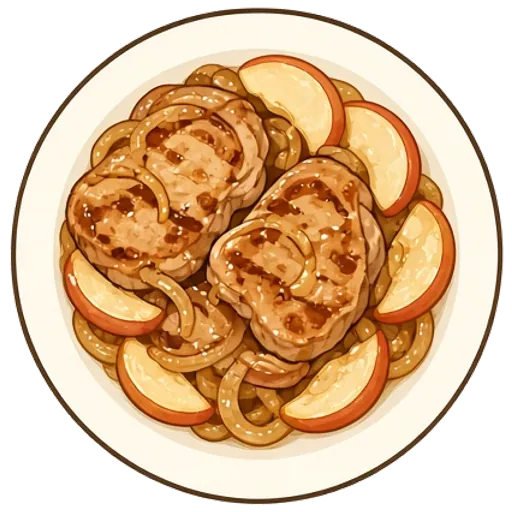
Pork chops with apples and onions
Golden pork chops with soft, buttery apples and a tangy pan sauce that tastes like fall.
- 35 min total
- 30 min hands-on
- Follow-a-recipe easy
- Serves 2
- About $2.67 a serving
- 520 calories
- Gluten-free

Dolly says: Read the steps once before you start. Everything goes smoother after that.
Ingredients
For 2 servings.
- 1 apple, cored and sliced
- ½ yellow onion, thinly sliced
- 2 boneless pork chops, about 1 inch thick
- 2 tbsp butter
- ½ cup chicken broth
- 1 tsp dijon mustard
From your pantry
- ¾ tsp salt
- ½ tsp black pepper
- 1 tbsp olive oil
- ½ tsp dried thyme
- 1 tbsp apple cider vinegar
Each serving has about 520 calories, 37 g protein, 18 g carbs and 34 g fat, and costs about $2.67 at typical US grocery prices. Both are estimates from what the recipe uses.
Missing something?
- No yellow onions? White onions or red onions work.
- No butter? Ghee works.
- No chicken broth? Vegetable broth or bone broth works.
Steps
Tap an underlined word for a quick explanation.
the apple and cut it into ¼-inch wedges, then the onion.
Core. Coring means cutting out the hard center of things like apples, peppers or cabbage. That center is tough and woody, so it’s the part you throw away.
How you’ll know: What’s left is all tender flesh, with no hard, pale center.
Thinly slice. Thinly slicing means cutting slices about an eighth of an inch thick, roughly two coins stacked. Thin slices cook in seconds and soften fast, which quick dishes need.
How you’ll know: A slice bends a little when you hold it by one edge, and slow, steady cuts beat fast ones.
 Dolly’s tip: Cut the apple into quarters first. The core comes out of each quarter with one angled cut.
the pork chops dry and both sides with the salt and pepper.
Pat dry. Patting dry means pressing paper towels onto food to soak up the moisture on its surface. Wet food steams instead of browning, so this is how you get a good sear and crisp skin.
How you’ll know: The surface feels tacky, not wet, and the last paper towel comes away barely damp.
Season. Seasoning means adding salt, pepper or spices to bring out a food’s flavor. A little at a few stages tastes better than a lot all at the end.
How you’ll know: When you taste it, it tastes bright and like itself, not flat and not salty.
Heat the oil in a large over medium-high until it . Lay in the chops and 4 minutes without moving them, until .
Skillet. A skillet is a frying pan: wide and flat with low, sloped sides. The shape lets steam escape, so food browns instead of stewing.
How you’ll know: It’s the pan you’d fry an egg in, and a 10 or 12 inch one handles most recipes.
Shimmering oil. Oil shimmers when it’s hot enough to cook: its surface looks rippled and wavy, like heat over a road. That’s your cue to add the food, just before the oil would start to smoke.
How you’ll know: The oil looks wavy and runs thin like water when you tilt the pan, with no smoke yet.
Sear. Searing means cooking the outside of meat or fish in a hot pan, without moving it, until a deep brown crust forms. The crust is packed with flavor, and it only forms on a dry surface.
How you’ll know: It sizzles loudly the moment it goes in, and it lets go of the pan on its own when the crust is ready.
Golden brown. Golden brown is the color of good toast, somewhere between yellow and light brown. It means the outside is cooked and crisp but not burnt.
How you’ll know: It looks like toast and smells toasty; dark brown with a bitter smell means it went too far.
Medium-high heatTimer: 4 min
Flip, turn the heat to medium, and cook 3 to 5 minutes more, until the middle reads 145°F. Move them to a plate to .
Rest. Resting means letting cooked meat sit for a few minutes before you cut it. It keeps cooking gently, and more of the juice stays in the meat instead of running onto the board.
How you’ll know: Loosely covered with foil, it stays hot, and very little juice runs out when you slice it.
Medium heatTimer: 4 min
Dolly’s tip: Pork is juiciest right at 145°F. A faint blush of pink in the middle is normal and safe.Food safety: Steak, pork chops and other whole cuts are safe at 145°F in the middle, then let them rest for 3 minutes before cutting.
Add the butter, apples, onion and thyme to the pan and cook 5 to 6 minutes, stirring now and then, until soft and at the edges.
Golden brown. Golden brown is the color of good toast, somewhere between yellow and light brown. It means the outside is cooked and crisp but not burnt.
How you’ll know: It looks like toast and smells toasty; dark brown with a bitter smell means it went too far.
Medium heatTimer: 5 min 30 sec
Pour in the broth and vinegar to , from the bottom of the pan.
Deglaze. Deglazing means pouring a splash of broth, wine or water into a hot pan to loosen the browned bits on the bottom. Those bits are full of flavor, and this turns them into the start of a sauce.
How you’ll know: It hisses and steams, and the bits lift easily when you scrape with a wooden spoon.
Scrape up the browned bits. It means loosening the brown bits stuck to the pan with a wooden spoon, usually right after adding liquid. Those bits are concentrated flavor, and they melt into the sauce.
How you’ll know: The bottom of the pan looks clean again, and the liquid turns darker and richer.
Medium heat
Stir in the mustard and let it bubble 2 to 3 minutes, until the sauce by about half and looks glossy.
Reduce. Reducing means simmering a liquid with the lid off so some of the water steams away. The sauce gets thicker and its flavor gets stronger.
How you’ll know: The level drops in the pan, and the sauce coats the back of a spoon instead of running off.
Medium heatTimer: 2 min 30 sec
Slide the chops and their juices back in for 1 minute, spooning the sauce over, then serve with the apples piled on top.
Low heatTimer: 1 min

Plan this in Dollop, and get the grocery list
Dollop puts this dinner on a night that suits your week, lists only what you still need to buy, and walks you through each step while you cook.