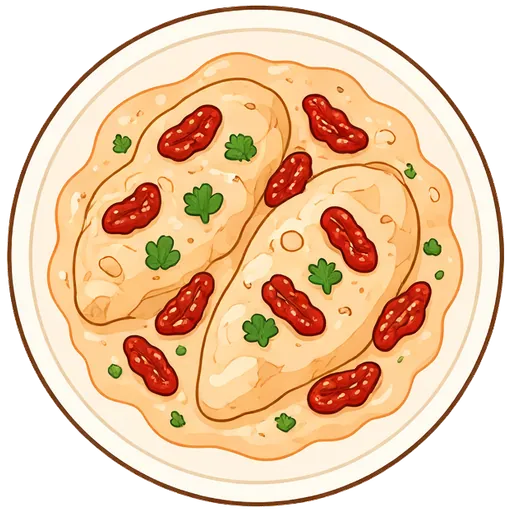
Marry me chicken
Chicken in a creamy sun-dried tomato and parmesan sauce that lives up to every bit of the hype.
- 35 min total
- 30 min hands-on
- Follow-a-recipe easy
- Serves 2
- About $4.00 a serving
- 680 calories
- Good the next day

Dolly says: Make the full amount. It’s just as good for lunch the next day.
Ingredients
For 2 servings.
- 2 chicken breasts
- 3 cloves garlic, minced
- ⅓ cup sun-dried tomatoes, chopped
- ½ cup chicken broth
- ½ cup heavy cream
- ⅓ cup grated parmesan
- ¼ cup fresh basil, torn (optional)
- 4 slices french bread (optional)
From your pantry
- ¾ tsp salt
- ½ tsp black pepper
- 1 tbsp olive oil
- 1 tsp italian seasoning
- ¼ tsp red pepper flakes (optional)
Each serving has about 680 calories, 59 g protein, 13 g carbs and 43 g fat, and costs about $4.00 at typical US grocery prices. Both are estimates from what the recipe uses.
Missing something?
- No chicken breasts? Boneless chicken thighs or chicken tenderloins work.
- No chicken broth? Vegetable broth or bone broth works.
- No grated parmesan? Parmesan wedge works.
- No french bread? Sourdough bread works.
Steps
Tap an underlined word for a quick explanation.
Lay each chicken breast flat, press it down with your palm, and through the middle, parallel to the board, to make two thin cutlets.
Slice. Slicing means cutting food into flat pieces of about the same thickness. Even slices cook evenly, so none are raw while others burn.
How you’ll know: Lay a few side by side: they’re close to the same thickness from one end to the other.
 Dolly’s tip: Go slowly with long strokes. Thin, even pieces cook through before the outside dries out.
the cutlets dry and both sides with the salt and pepper.
Pat dry. Patting dry means pressing paper towels onto food to soak up the moisture on its surface. Wet food steams instead of browning, so this is how you get a good sear and crisp skin.
How you’ll know: The surface feels tacky, not wet, and the last paper towel comes away barely damp.
Season. Seasoning means adding salt, pepper or spices to bring out a food’s flavor. A little at a few stages tastes better than a lot all at the end.
How you’ll know: When you taste it, it tastes bright and like itself, not flat and not salty.
Heat the oil in a large over medium-high until it . Cook the chicken 4 minutes without moving it, until underneath.
Skillet. A skillet is a frying pan: wide and flat with low, sloped sides. The shape lets steam escape, so food browns instead of stewing.
How you’ll know: It’s the pan you’d fry an egg in, and a 10 or 12 inch one handles most recipes.
Shimmering oil. Oil shimmers when it’s hot enough to cook: its surface looks rippled and wavy, like heat over a road. That’s your cue to add the food, just before the oil would start to smoke.
How you’ll know: The oil looks wavy and runs thin like water when you tilt the pan, with no smoke yet.
Golden brown. Golden brown is the color of good toast, somewhere between yellow and light brown. It means the outside is cooked and crisp but not burnt.
How you’ll know: It looks like toast and smells toasty; dark brown with a bitter smell means it went too far.
Medium-high heatTimer: 4 min
Flip and cook 2 minutes more, then move the chicken to a plate. It will finish cooking in the sauce.
Medium-high heatTimer: 2 min
Dolly’s tip: It’s fine if it’s still a little pink inside here. The sauce takes it the rest of the way.Turn the heat to medium, add the garlic, sun-dried tomatoes, Italian seasoning and pepper flakes, and stir 1 minute, .
Fragrant. Fragrant means cooking until you can clearly smell it, usually garlic or spices, often in about 30 seconds. That’s the moment the flavor is ready, just before it can burn.
How you’ll know: You can smell it from a step back, and garlic is pale gold, not brown.
Medium heat
Pour in the broth and , then stir in the cream and parmesan.
Scrape up the browned bits. It means loosening the brown bits stuck to the pan with a wooden spoon, usually right after adding liquid. Those bits are concentrated flavor, and they melt into the sauce.
How you’ll know: The bottom of the pan looks clean again, and the liquid turns darker and richer.
Medium heat
Bring to a gentle and let it bubble 3 to 4 minutes, until it enough to coat a spoon.
Simmer. Simmering means keeping a liquid just below a boil, with small bubbles rising gently. It cooks food evenly and lets a sauce thicken without scorching on the bottom.
How you’ll know: Small, lazy bubbles break the surface every second or so, and nothing is churning.
Thicken. Thickening means cooking a sauce or soup until it’s less runny, by simmering it down or adding something like cornstarch. A thicker sauce clings to food instead of pooling on the plate.
How you’ll know: It coats the back of a spoon, and a line drawn through it with your finger holds its shape.
Medium heatTimer: 3 min 30 sec
Slide the chicken and its juices back in and 3 to 4 minutes, spooning sauce over the top, until the thickest piece reads 165°F.
Simmer. Simmering means keeping a liquid just below a boil, with small bubbles rising gently. It cooks food evenly and lets a sauce thicken without scorching on the bottom.
How you’ll know: Small, lazy bubbles break the surface every second or so, and nothing is churning.
Low heatTimer: 3 min 30 sec
Food safety: Chicken is done at 165°F in the thickest part. A thermometer is the only sure check. Without one, cut into the thickest piece: it should be white all the way through, with no pink.
Scatter the basil over the top and serve with bread for the sauce.

Plan this in Dollop, and get the grocery list
Dollop puts this dinner on a night that suits your week, lists only what you still need to buy, and walks you through each step while you cook.